You have visitors coming to your store, but too few of them are buying. That gap between traffic and sales is the most frustrating problem in eCommerce, and it is exactly what conversion rate optimization solves.
WooCommerce conversion rate optimization (CRO) is the process of making better use of the traffic you already have. Instead of spending more to bring in visitors, you refine your product pages, tighten your checkout, and remove the friction that stops people from buying, so more of your existing visitors reach the finish line.
This guide covers 9 proven, on-site CRO strategies, each with clear steps to implement. Let’s get started.
Drive more conversions with targeted upsells and cross-sells.
Table of contents
- What is a Good Conversion Rate in WooCommerce?
- 9 Proven WooCommerce Conversion Rate Optimization Strategies
- 1. Optimize Your Product Pages to Convert
- 2. Remove Checkout Friction
- 3. Build Trust with Social Proof
- 4. Recover Abandoned Carts
- 5. Add Scarcity and Urgency
- 6. Personalize the Shopping Journey
- 7. Optimize for Mobile and Page Speed
- 8. Run A/B Tests to Decide with Data
- 9. Measure and Analyze Your Conversion Metrics
- Turn Conversions into Long-Term Growth
- Conclusion
- Frequently Asked Questions
What is a Good Conversion Rate in WooCommerce?
The average conversion rate for a WooCommerce store is typically between 2% and 4%, though it varies with your industry, audience, pricing, and traffic quality. Higher-priced or niche products often convert lower, while well-optimized stores with fast, frictionless checkouts can exceed that range.
Here is why the number matters so much: conversion rate is a multiplier on everything else you do. Even a 1% increase in conversion rate can translate into thousands in extra revenue, because you are earning more from traffic you have already paid for or worked to attract. That is what makes CRO the highest-return work in most stores.
To understand where CRO fits, it helps to see where stores actually lose sales.

Every stage of that funnel is a place where visitors drop off, and every drop-off is a conversion you can recover. The nine strategies below work through the funnel from the product page to the final click.
9 Proven WooCommerce Conversion Rate Optimization Strategies

1. Optimize Your Product Pages to Convert
The product page is where most buying decisions happen, so it is the highest-impact page to optimize for conversions. A visitor arriving here is already interested; your job is to remove every reason to hesitate.
How to Implement?
- Use high-quality images that show the product from multiple angles, plus a short video demonstration where possible. Video gives a fuller sense of the product and reduces uncertainty.
- Write clear, benefit-led descriptions that answer the questions a buyer actually has, not just spec sheets.
- Make the price and the “Add to Cart” button prominent and above the fold, with an unmissable, high-contrast CTA.
- Place reviews and ratings directly on the product page so proof sits right where the decision is made.
- Add product add-ons and frequently bought together suggestions to help buyers complete their purchase.
2. Remove Checkout Friction
A complicated checkout is where hard-won conversions die. Every extra step, field, or moment of doubt gives a ready buyer a reason to leave. Streamlining checkout is often the single fastest conversion win available to a WooCommerce store, and in 2026 it is more tied to WooCommerce’s own features than many owners realize.
How to Implement?
- Offer a guest checkout option so customers can buy without creating an account.
- Reduce the number of form fields to the essentials, and use address autocomplete to speed the rest.
- Add wallet payments like Apple Pay and Google Pay, which let returning shoppers pay in a tap and measurably lift completion rates.
- Use WooCommerce’s newer Checkout Blocks for a faster, more optimized checkout than the classic shortcode-based one.
- Show a clear order summary and security/trust icons at the point of payment so there are no surprises.
- Recommend a relevant upsell at checkout to lift order value without adding friction.
Related read: Choose the right WooCommerce checkout plugin to streamline this stage.
3. Build Trust with Social Proof
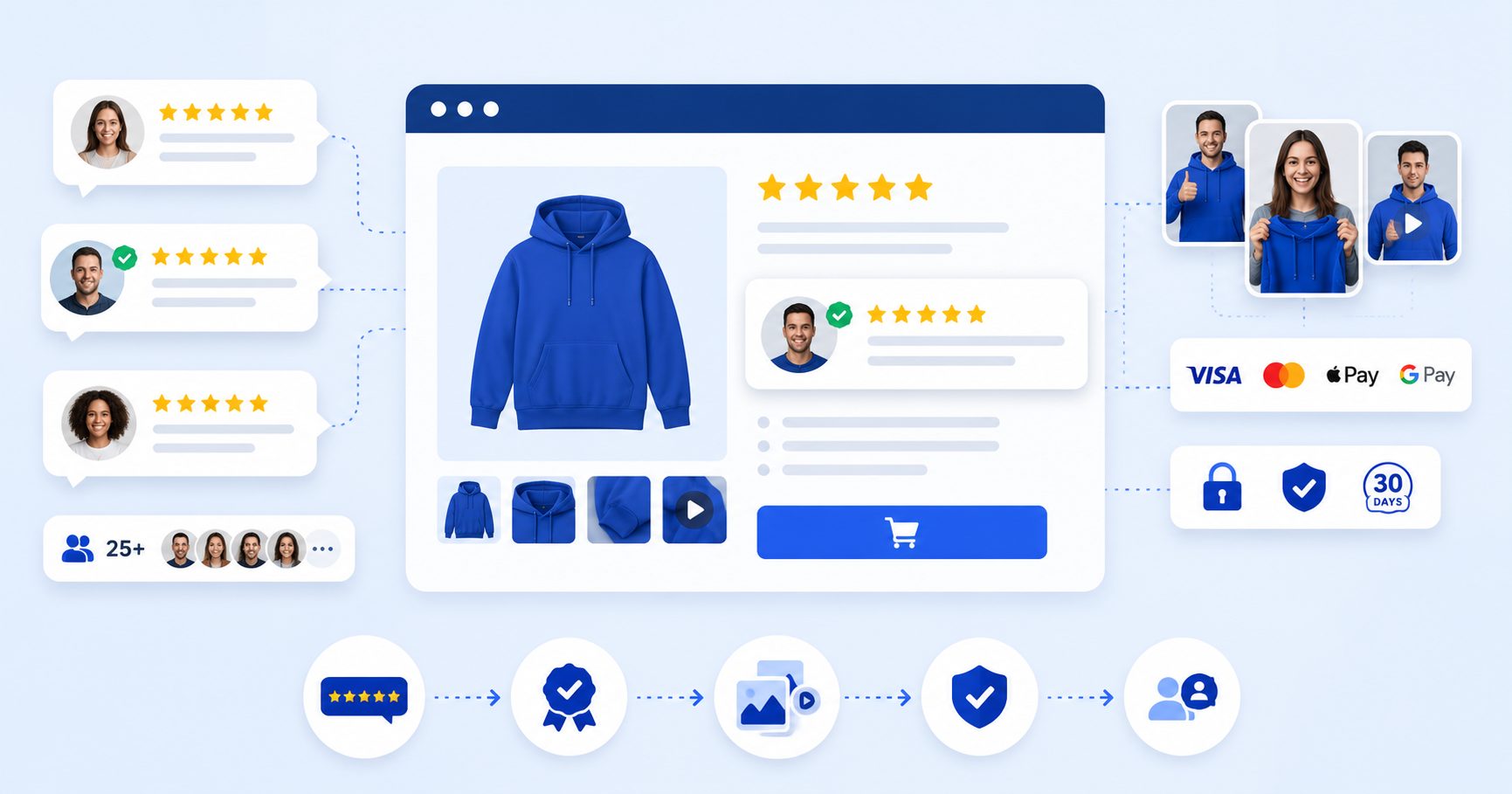
Shoppers convert when they see that other people bought and were happy. Social proof is one of the most reliable trust-builders in eCommerce, directly reducing the doubt that stops a purchase.
How to Implement?
- Show product reviews and star ratings prominently on product pages, and pin your best reviews to the top.
- Prioritize reviews from verified buyers, which carry far more credibility.
- Add photo and video reviews from real customers, which convert better than text alone.
- Display trust badges (secure checkout, payment providers, guarantees) near the “Add to Cart” and checkout buttons.
- Consider a subtle “X people bought this recently” signal to show live demand.
4. Recover Abandoned Carts
Cart abandonment is one of the biggest conversion leaks in any store: the shopper wanted the product enough to add it, then left before paying. Recovering even a fraction of those carts is pure recovered conversion.
How to Implement?
- Send an automated cart-recovery email sequence, starting within an hour of abandonment while intent is still fresh.
- Personalize the emails with the exact items left behind and a clear button back to checkout.
- Offer a small incentive, such as free shipping or a modest discount, in a follow-up email to tip hesitant buyers over the line.
- Trigger an exit-intent reminder when a shopper moves to leave the cart or checkout page.
Note: We use Retainful for WooCommerce cart-recovery emails, so we recommend it to our readers.
5. Add Scarcity and Urgency

Scarcity and urgency create the gentle push that turns “maybe later” into “buy now.” When shoppers sense an offer or a product is limited, they act rather than delay, which lifts conversions on the spot.
How to Implement?
- Show a countdown timer on time-limited offers to make the deadline concrete.
- Display low-stock indicators (“Only 3 left”) on product pages where it is genuinely true.
- Keep urgency honest. Real scarcity builds trust and converts; fake timers erode both.
- Add “fast shipping” or “order within X hours” labels to prompt last-minute buyers.
6. Personalize the Shopping Journey
A store that feels tailored to each visitor converts better than a one-size-fits-all one. Personalization connects shoppers with products they are actually likely to want, shortening the path to purchase.
How to Implement?
- Show related product recommendations based on what the visitor is viewing.
- Trigger upsell popups based on browsing behavior and cart contents.
- Tailor offers and discounts to customer segments, such as first-time versus returning buyers.
- Recommend complementary items on the cart page so the suggestion arrives at the right moment.
Related read: See the best WooCommerce related product plugins to power personalized suggestions.
7. Optimize for Mobile and Page Speed

More than two-thirds of eCommerce traffic is on mobile, and speed is decisive on every device. A slow or clumsy mobile experience is one of the biggest silent conversion killers, since even a small delay measurably lowers conversion rates.
How to Implement?
- Use a lightweight, responsive theme that adapts cleanly to every screen size.
- Compress images and enable caching so pages load fast, and keep an eye on your Core Web Vitals.
- Make buttons large and easy to tap, and keep the mobile checkout to as few fields as possible with autofill enabled.
- Test the full journey on a real phone, from product page to payment, and fix anything awkward.
8. Run A/B Tests to Decide with Data
CRO works best when you replace opinions with evidence. A/B testing lets you compare two versions of a page element and keep the one that actually converts better, so every change is tied to a real conversion lift rather than a guess.
How to Implement?
- Test one element at a time — a CTA label, a headline, a product image, a button color — so you know what caused the change.
- Run each test long enough to reach a meaningful result before deciding.
- Start with your highest-traffic, highest-impact pages (product and checkout) where a small lift means the most.
- Keep the winner, then move on to the next test. CRO is a habit, not a one-off.
9. Measure and Analyze Your Conversion Metrics
You cannot optimize what you do not measure. Tracking your conversion data tells you exactly where visitors drop off, so your effort goes to the fixes that matter instead of guesswork.
How to Implement?
- Connect Google Analytics to WooCommerce to track traffic, behavior, and conversion rate accurately.
- Map your conversion funnel from product view to checkout to purchase, and find the stage with the biggest drop-off.
- Segment your data by device, traffic source, and customer type to see where the problems concentrate.
- Review the numbers regularly and let each finding feed your next A/B test, closing the loop.
The conversion rate formula: divide your total number of orders by your total number of visitors, then multiply by 100. Pull orders from your WooCommerce dashboard and visitors from Google Analytics.
Increase conversions with a simple, streamlined checkout using UpsellWP’s side cart and checkout upsell features.
Turn Conversions into Long-Term Growth
A higher conversion rate does more than lift today’s revenue. It increases customer lifetime value, lowers your customer acquisition cost (because you earn more from the same traffic), and compounds the return on every marketing dollar you spend. That is why CRO is the highest-leverage work most stores can do.
The strategies here focus on converting the visitors you already have. To keep growing, pair them with the other half of the equation — bringing more of the right traffic to your store. Our guide on how to increase WooCommerce sales covers the traffic and demand side, from SEO to email to paid ads. Run both together, and that is how a store grows sustainably.
Conclusion
WooCommerce conversion rate optimization is not a single fix; it is an ongoing cycle of measuring, testing, and refining. Start with the biggest leak in your funnel — usually the product page or checkout — apply the relevant strategy above, measure the result, and move to the next. Small, data-backed improvements compound into a meaningfully higher conversion rate over time.
Curated guides to boost your WooCommerce conversions:
- Order Bump Vs Upsell: What is the Difference?
- Essential WooCommerce Marketing Plugins
- Best WooCommerce Coupon Plugins
- WooCommerce exit intent popup plugins
Frequently Asked Questions
A typical WooCommerce conversion rate is between 2% and 4%, though it varies by industry, price point, and traffic quality. Well-optimized stores with fast, frictionless checkouts can exceed 4%. A rate near 1% is below average and signals room to improve.
Common causes are slow page load times, a complicated checkout, missing trust signals, weak product images or descriptions, and unclear calls to action. Diagnosing which stage of your funnel loses the most visitors tells you where to focus first.
Reduce friction: offer guest checkout, cut form fields, add wallet payments like Apple Pay and Google Pay, use WooCommerce Checkout Blocks, and show trust badges at payment. These changes remove the most common reasons shoppers abandon checkout.
Divide your total number of orders by your total number of visitors, then multiply by 100. For example, 15 orders from 1,000 visitors is a 1.5% conversion rate. Pull orders from WooCommerce and visitors from Google Analytics.
Conversion rate measures how well you turn visitors into buyers, while average order value measures how much each buyer spends. CRO grows the number of buyers; upselling and cross-selling grow the value of each order. Both raise revenue.
Yes. CRO increases sales from your existing traffic by converting more visitors into buyers, so you earn more without spending more on traffic. Even a 1% conversion lift can add significant revenue, which is why CRO delivers such a high return.
UpsellWP (for upsells and recommendations), a cart-recovery tool like Retainful, and a loyalty plugin like WPLoyalty are strong choices. The right mix depends on which stage of your funnel needs the most improvement.